What happens to your furniture after collection
Once a wardrobe or a dining table is on the van, most people never think about it again. Here is the honest account of where it goes, what gets reused, what gets recovered and what the paperwork behind it means for you.
Key points
- A piece that is sound and clean is offered for reuse before it goes anywhere near a waste facility.
- Everything else goes to a licensed waste transfer station, where wood, metal and glass are separated for recovery.
- Solid timber, chipboard and MDF are handled differently, and metal frames and glass doors each have their own stream.
- Around 90% of what we collect is recycled, and a waste transfer note is available on request for every job.
- Our upper tier waste carrier licence, CBDU526130, is registered with the Environment Agency and protects you as well as us.
Reuse first, where a piece is sound
Not every piece of furniture that leaves a home is waste. A solid pine chest of drawers with sticky runners, a dining table with a scratched top or an office chair that was simply replaced can all go on to another owner. When the crew lifts something onto the van and it is structurally sound, clean and complete, it is set aside for reuse rather than taken to the transfer station. That is the best outcome for the piece and the material in it.
Reuse depends on condition rather than age. A wardrobe with a split side panel or missing doors is not reusable however good the timber is, and a flat-pack bookcase that has been dismantled once rarely survives a second assembly. The crew makes that judgement when they see the piece, so if you know a table or a cabinet is still good, say so when you send the photo.
If you would rather arrange reuse yourself before booking a collection, will a charity collect my furniture explains what furniture charities accept and what they turn away, and how the fire label rules and condition checks work.
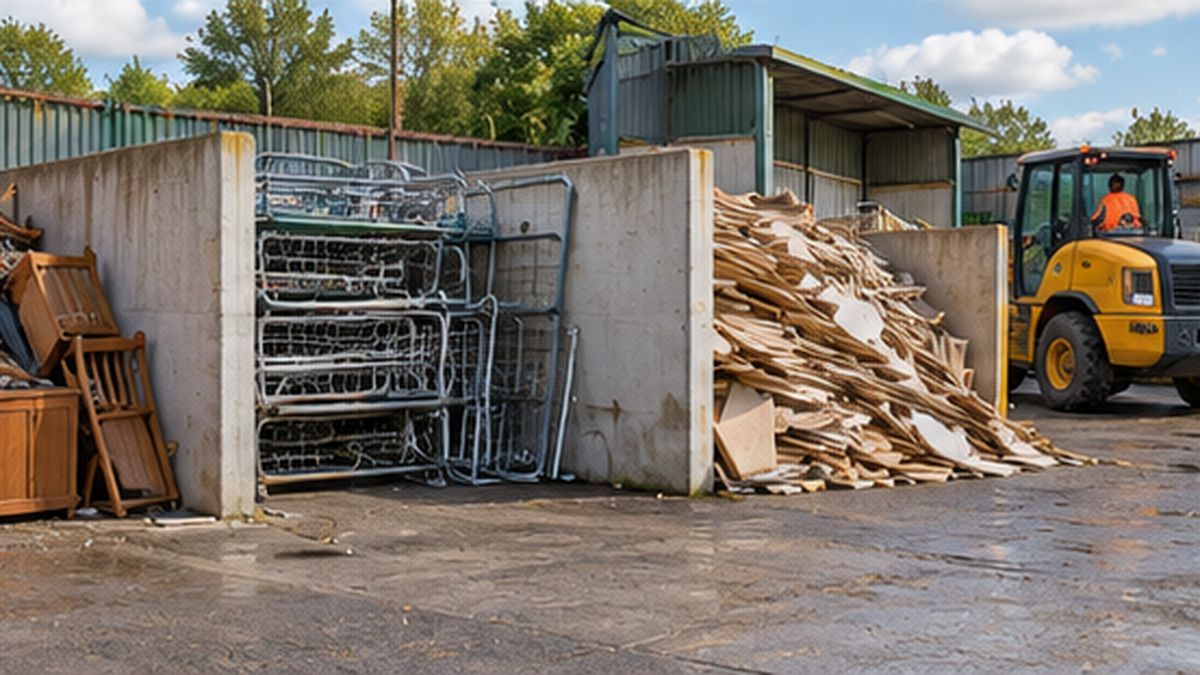
The licensed waste transfer station
Everything that is not reused goes to a licensed waste transfer station. This is a permitted site where mixed waste is tipped, sorted and separated into material streams, each of which is then sent on to a processor. The van is weighed in, the load is tipped in a bay for bulky waste, and the site's own team and machinery pull it apart by material. The van is weighed out and the difference is recorded against our licence.
A transfer station is not a landfill and it is not a tip in the household sense. It is the step between the collection vehicle and the recycling or recovery facilities, and its job is to make sure as much as possible is recovered and as little as possible ends up in the residual stream. The site is permitted and inspected, which is how the figure of 90% recycled is reached.
You do not need to know which site took your particular wardrobe, but you can ask. The waste transfer note we provide on request records where the load went, and the furniture disposal page explains how to request one when you book.
Want it collected and disposed of properly?
Send a photo of the furniture and we reply with one fixed price. Two people carry it out, it goes for reuse or to a licensed transfer station, and a waste transfer note is yours on request.
How wood is separated and recovered
Wood is the biggest stream from household furniture, and it is sorted into grades. Solid timber from an old table, a pine bed frame or a hardwood wardrobe is clean wood. It is chipped and goes into new board products, animal bedding or biomass fuel depending on grade and demand. Painted or varnished solid timber is a lower grade but still recoverable in most cases.
Chipboard and MDF, which make up most flat-pack furniture, are a different story. Both are made from wood fibres bound with resin, and chipboard often carries a melamine or foil face. They cannot be chipped back into clean wood, so they go into a lower grade stream used for board manufacture or energy recovery. A flat-pack wardrobe is still recovered rather than buried, but it will not become another piece of solid furniture.
Before the wood is chipped, the metal has to come out of it. Hinges, cam locks, drawer runners, bed bolts and castors are picked off by hand or pulled out by magnets after shredding. That is partly why the crew takes a piece apart in the room when they can: a panel with its fittings already removed is a cleaner load at the other end.
Metal frames and glass doors
Metal furniture is the easiest material to recover and the most valuable. A steel bed frame, a filing cabinet, the legs of a glass dining table or the frame of a desk chair are all pulled into the metal stream at the transfer station and sent to a scrap processor, where ferrous and non-ferrous metals are separated and melted down. Metal is recycled almost indefinitely without losing quality, so a steel bunk bed genuinely becomes new steel.
Glass needs more care. Mirrored wardrobe doors, display cabinet shelves and glass table tops are removed from their frames before the wood or metal is processed, because glass contaminates both streams. Flat glass from furniture is collected separately from bottle glass and goes to a flat glass processor, or where it is mirrored or laminated it goes to a stream that can handle the backing. Glass that is already broken inside a cabinet is contained and dealt with separately, which is why the crew tapes glass doors before they go on the van.
If you are clearing a display cabinet or sideboard with glass in it, leave the glass in place and let the crew handle it. Taking glass out yourself without the right gloves is how people get hurt, and it makes no difference to the price.
What cannot be recycled
A small proportion of what comes out of a home cannot be recovered as material. Laminates that have delaminated into layers, composite panels with foam cores, heavily damp or rotten chipboard, plastic trims and fabric that is glued to a board rather than stapled all tend to end up in the residual stream. So does anything contaminated with paint, oil or animal waste that cannot be cleaned off.
Residual waste from a licensed transfer station is not fly-tipped and is not simply buried if there is an alternative. It typically goes for energy recovery, where it is burned to generate power under permit, with landfill as the last resort. The proportion of furniture that ends up there is the gap between the 90% we recycle and the whole, and the crew's work in the room, separating glass, pulling fittings and keeping timber whole, is part of what keeps that gap small.
Garden furniture is the category most likely to produce residual waste. Rotten softwood benches, sun-bleached plastic chairs and rattan that has unravelled are hard to recover, though the steel or aluminium in a patio set is always pulled out first. See the garden furniture removal page for how those loads are handled.
The waste transfer note and your duty of care
Anyone in the UK who produces waste, including a householder getting rid of a wardrobe, has a duty of care to make sure it ends up somewhere legal. For a householder, that means taking reasonable steps to check that whoever takes your furniture away is authorised to do so. If you hand furniture to someone without a licence and it is found dumped in a lane, you can be held responsible, not just the person who dumped it.
The waste transfer note is the document that closes that loop. It records who the waste came from, who carried it, what it was and where it was taken. We provide one on request for every collection, and it is worth asking for if you are a landlord, a letting agent or a business clearing an office, because it is your evidence that the furniture was disposed of properly. For a householder it is a simple piece of reassurance that costs nothing to ask for.
If you are considering other routes, can furniture go in a skip looks at what the duty of care means when you hire a skip instead, and the how to get rid of old furniture guide compares every option side by side.
Why the waste carrier licence matters to you
Our licence is an upper tier waste carrier registration, number CBDU526130, held with the Environment Agency and covering England and Wales. Upper tier is the level required for anyone who carries other people's waste as a business, and it means the Environment Agency knows who we are, can inspect what we do and can act if we break the rules. You can check the number on the public register in a minute, and any legitimate carrier will give you theirs without being asked twice.
For you, the licence is the difference between a collection you can trust and a van that might be heading for a lay-by. It is backed by public liability insurance of £5 million and employers' liability of £10 million, so a scraped wall or a dropped carcass is covered. After 15+ years and 500+ collections, the route from your bedroom to the transfer station is a familiar one, and the 5 star rating on Google reflects that. Send a photo, get one fixed price, and know where the furniture is going before it leaves the house.
Questions people ask
Will you tell me whether my furniture was reused or recycled?
We can tell you where the load went, and the waste transfer note records the site. Whether an individual piece was passed on for reuse depends on its condition when the crew saw it, and we are honest about that rather than promising every piece finds a new home.
Does flat-pack furniture actually get recycled?
Yes, but into a lower grade stream than solid timber. Chipboard and MDF are recovered for board manufacture or energy rather than chipped into clean wood, and the metal fittings are pulled out first.
Do I need a waste transfer note as a householder?
You are not obliged to hold one, but it is your proof that the furniture was carried by a licensed carrier to a permitted site. Ask for it when you book and we will send it after the collection.
What does the 90% recycled figure cover?
It is the share of the furniture we collect that is recovered as material or passed on for reuse rather than going into the residual stream. The remainder is mainly damp or delaminated board, foam-cored panels and glued fabric that no facility can recover.
Ready to book a collection?
Fill in the form and we reply with a fixed price for collecting the furniture from inside your home or business. Then send us a photo so the price is right first time.
- Registered waste carrier
- Fixed price from a photo
- Two-person crew and van
- Same or next day where possible

Get a fixed price from a photo
Fill this in and we reply by email with a fixed price. Then send us a photo of the furniture so the price is right first time.
Sent.
No email app on this device? Send the photo to hello@furniture-removal.co.uk with your postcode.